
June 4, 2026
Milbank LLP just raised associate salaries by $10,000 to $20,000 across class years. Other Big Law firms are expected to follow, as they always do.
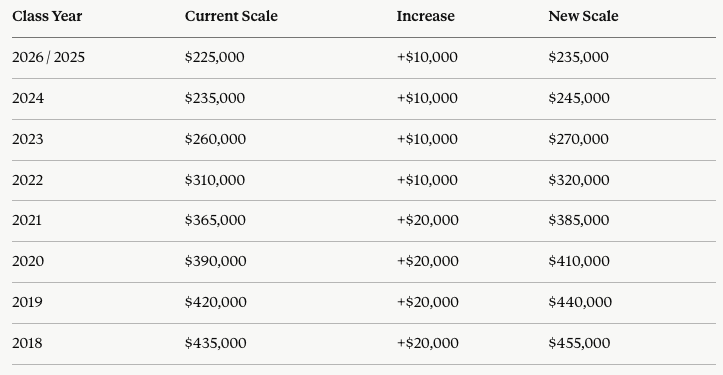
$10,000 to $20,000 is a meaningful bump. But the number that matters most isn't your new gross salary, it's what actually lands in your bank account after taxes. To show you what that looks like in practice, I ran the numbers for three hypothetical Big Law associates:
- Married sixth-year associate in Dallas, TX
- Single third-year associate in New York City, NY
- Married eighth-year associate in Los Angeles, CA
Note: All figures use 2026 federal and state tax rates and assume the standard deduction. Bonuses, retirement contributions, employee benefits, spouse income, and tax credits are excluded for simplicity. The net per paycheck amount assumes you receive (24) bi-monthly paychecks. Your actual take-home might differ.
Associate #1: Married Sixth-Year in Dallas. TX
Dallas has no state income tax, so this associate's tax picture is simpler than most.
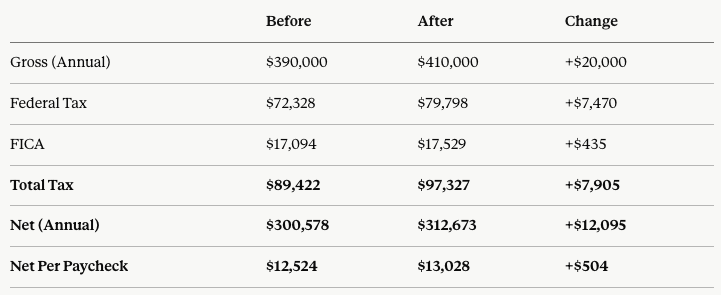
Of the $20,000 raise, this associate keeps roughly $12,095, or about 60 cents on the dollar.
Associate #2: Single Third-Year in New York City, NY
NYC associates face federal taxes, New York State income tax, and New York City resident tax, one of the highest combined tax burdens in the country.
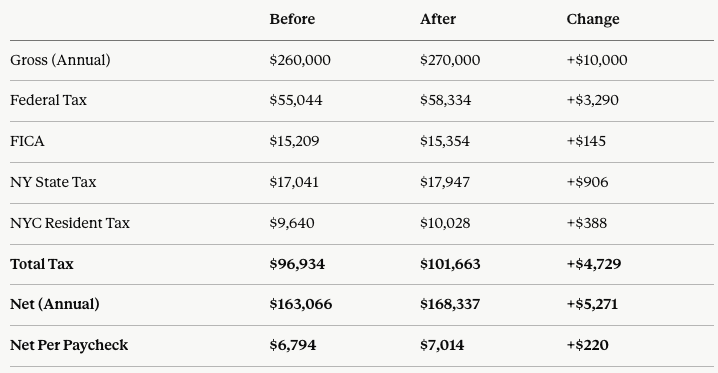
Of the $10,000 raise, this associate keeps roughly $5,271, or about 53 cents on the dollar.
Associate #3: Married Eighth-Year in Los Angeles, CA
California's high state income tax means this associate faces a significant haircut, even at the top of the associate pay scale.
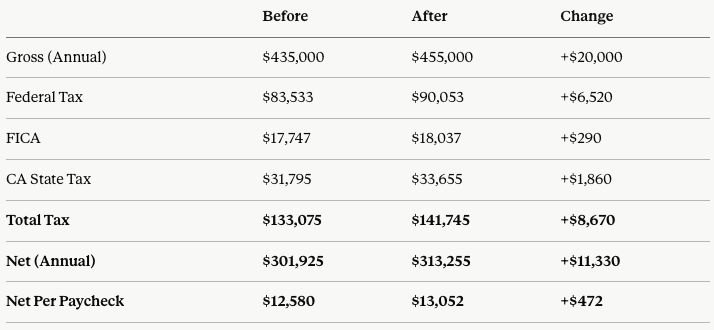
Of the $20,000 raise, this associate keeps roughly $11,330, or about 57 cents on the dollar.
Bottom Line
Across all three scenarios, Big Law associates keep somewhere between 53 and 60 cents of every new dollar earned, which is still significant. But a pay increase only improves your financial picture if you're intentional about where it goes.
Here's the pattern I see with high-income earners: the raise hits, their lifestyle adjusts, and six months later, the money is gone. A couple of nice dinners, a weekend trip, a new work outfit, none of it unreasonable on its own, but collectively enough to wipe out the entire increase. I'm not saying don't enjoy it. Spending on things that genuinely matter to you is the point. But lifestyle creep is subtle, and it tends to win.
The associates who come out ahead are the ones who allocate before they spend. That might mean bumping up your 401(k) contribution, accelerating student loan payments, or building toward a down payment on a house. Even directing half the after-tax increase toward a specific savings goal makes a meaningful difference over time.
Need help making a plan?
If you're a Big Law associate and you're not sure where this raise should go, that's exactly the kind of question I help answer. SharpEdge Financial is a fee-only financial planning firm built specifically for attorneys at firms like yours.
📅 Schedule your free introductory call
💼 Learn more about our services & pricing
About SharpEdge Financial
SharpEdge Financial is a fee-only financial planning firm serving Millennial and Gen Z attorneys. Whether you’re just starting out in Big Law or approaching a career transition, we’re here to guide you through the complex decisions that come with high-income professional life.
What does fee-only mean? Our clients pay us to give them holistic, unbiased advice. That’s it. We do not sell commission-based products, so we have the freedom to develop your financial plan and investment strategy free of outside influence.
Are you a fiduciary? The fiduciary standard is the highest standard of care. As a fiduciary to our clients, we always make recommendations that are in your best interest, not ours.
Why are you independent? As an independent Registered Investment Adviser, we have the flexibility to serve our clients in the way that best meets your needs. No outside influence from a large corporation.
SharpEdge Financial LLC is a registered investment adviser registered with the State of Texas. Registration does not imply a certain level of skill or training. The views and opinions expressed are as of the date of publication and are subject to change. The content of this publication is for informational or educational purposes only. This content is not intended as individualized investment advice, or as tax, accounting, or legal advice. Although we gather information from sources that we deem to be reliable, we cannot guarantee the accuracy, timeliness, or completeness of any information prepared by any unaffiliated third-party. When specific investments or types of investments are mentioned, such mention is not intended to be a recommendation or endorsement to buy or sell the specific investment. The author of this publication may hold positions in investments or types of investments mentioned. This information should not be relied upon as the sole factor in an investment-making decision. Readers are encouraged to consult with professional financial, accounting, tax, or legal advisers to address their specific needs and circumstances.